Massive Instagram Data Leak Exposes 17.5 Million Users; Data Found on Dark Web
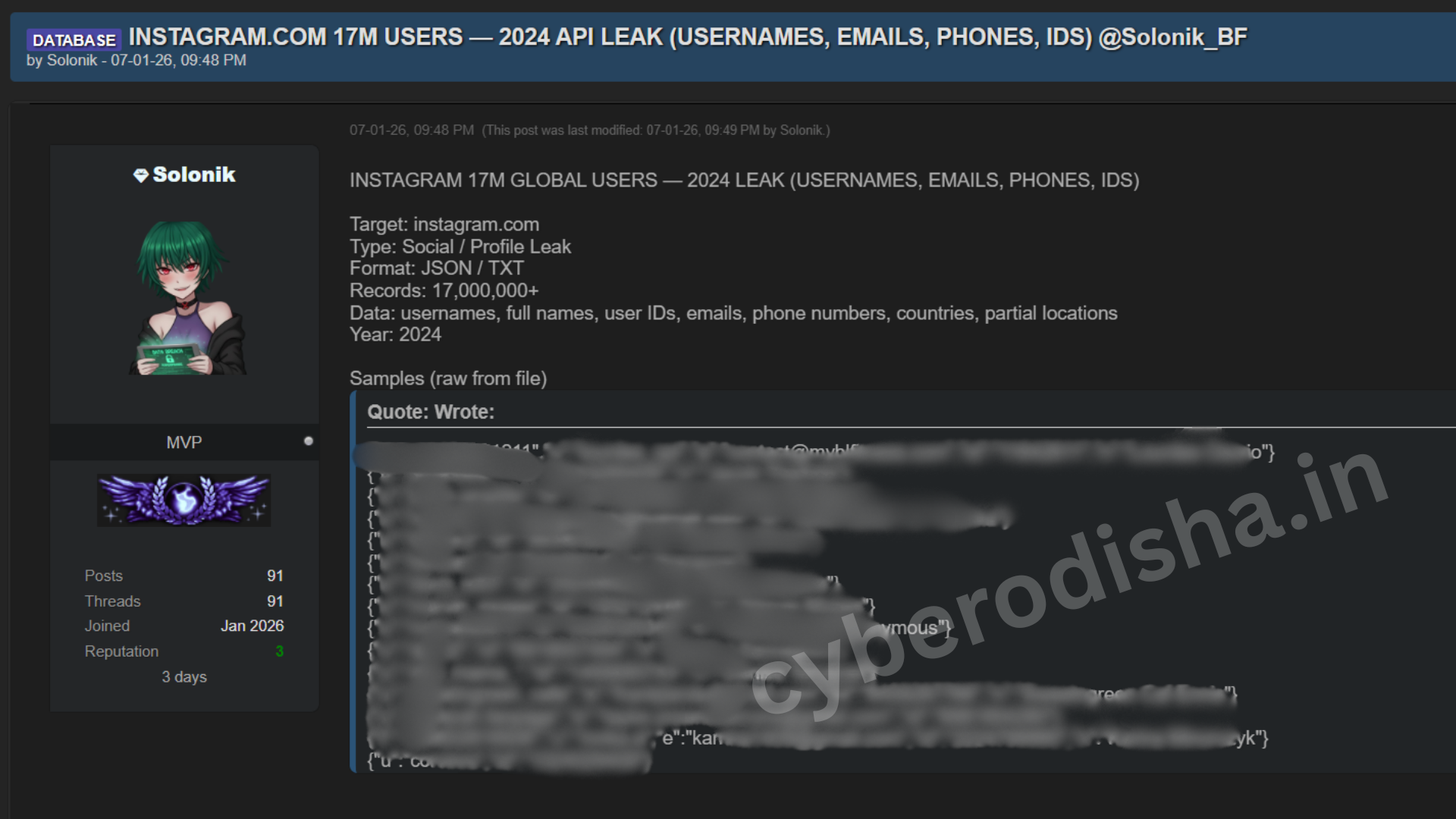
A large-scale data breach involving Instagram has come to light, with the personal information of nearly 17.5 million users reportedly circulating on dark web forums. The incident, linked to a vulnerability discovered in 2024, has raised fresh concerns about data privacy, cyber crime, and the growing threat landscape surrounding social media platforms.
Cybersecurity researchers have confirmed that the leaked dataset contains sensitive user information and is being actively traded among threat actors. The breach was first flagged by security analysts and later traced to an API-related flaw that enabled mass profile scraping.
Details of the Breach
According to cybersecurity reports, the leaked database includes more than 17 million records and is available in JSON and TXT formats, making it easily accessible for malicious use. The exposed data reportedly contains:
- Usernames
- Full names
- User IDs
- Email addresses
- Phone numbers
- Country details and partial location information
Although passwords were not directly exposed, experts warn that the leaked data is sufficient to conduct highly targeted phishing and social engineering attacks.
The dataset was allegedly shared on underground cybercrime forums by a threat actor using the alias “Solonik.” Security firm Malwarebytes linked the breach to an API vulnerability that existed during 2024 and allowed automated scraping of user profiles at scale.
Rising Risk of Cyber Crime and Phishing Attacks
Following the leak, cybersecurity professionals have reported an increase in fake Instagram password reset emails and fraudulent login alerts targeting affected users. These phishing campaigns closely mimic official Instagram communications, making them difficult for unsuspecting users to identify.
Such attacks demonstrate how dark web data breaches often lead to secondary threats, including account takeovers, identity fraud, SIM swap attacks, and financial scams. Once personal data enters dark web marketplaces, it can be reused indefinitely across multiple attack campaigns.
Experts stress that this incident highlights the evolving nature of cyber crime, where attackers increasingly rely on data exploitation rather than traditional hacking techniques.
Lack of Official Statement from Meta
As of now, Meta, Instagram’s parent company, has not issued an official statement addressing the resale or circulation of this specific dataset. However, similar incidents in the past have prompted calls for stronger API security, improved monitoring systems, and faster disclosure practices.
The absence of immediate clarification has left users uncertain about whether their data was affected, reinforcing the importance of individual cyber hygiene.
Cyber Security Implications
From a cyber security standpoint, this breach underscores the risks associated with unsecured or poorly monitored APIs. Unlike conventional breaches that involve system intrusion, API scraping often exploits design gaps, rate-limit weaknesses, or excessive data exposure.
For government-led awareness initiatives such as Cyber Odisha, this incident serves as a real-world example of why digital safety education and rapid cyber crime response mechanisms are essential.
Ethical hackers and cybersecurity researchers continue to emphasize the need for proactive security testing, responsible disclosure programs, and collaboration between platforms and independent security experts.
What Users Should Do
Cybersecurity professionals advise Instagram users to take immediate precautionary steps:
- Be alert to suspicious emails or messages claiming to be from Instagram
- Avoid clicking unknown password reset or verification links
- Enable two-factor authentication (2FA)
- Use strong, unique passwords
- Monitor accounts for unusual activity
Staying informed remains one of the most effective defenses against cyber crime.
Conclusion
The exposure of 17.5 million Instagram users is a stark reminder of the scale at which personal data can be collected and misused in today’s digital ecosystem. As dark web data breaches become more frequent, the responsibility to protect user information lies not only with platforms but also with users and the broader cyber security community.
The incident reinforces the growing importance of ethical hackers, robust cyber security practices, and public awareness initiatives in mitigating digital risks and maintaining trust in online platforms.









Post Comment